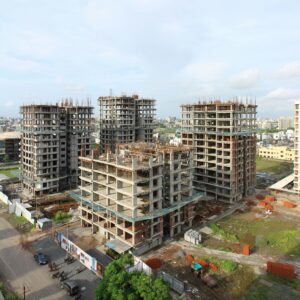
The dream of owning a home is deeply ingrained in the heart of the Indian middle class. However, a growing paradox is casting a long shadow over this aspiration. While the demand for affordable housing has never been stronger, the supply is inexplicably shrinking. Instead, skylines across major cities are increasingly being dominated by luxury projects, pushing the goal of homeownership further away for millions. This mismatch isn’t just a statistic; it’s a crisis unfolding in plain sight.
India’s housing market is at a critical juncture. On one hand, government initiatives aim to provide “Housing for All.” On the other, economic realities are forcing developers to cater almost exclusively to the affluent. Let’s delve into the complex factors fueling this affordable housing crisis.
The Great Supply-Demand Mismatch
The numbers paint a stark picture of the current real estate landscape. According to recent data from real estate consultants ANAROCK Property Consultants, the share of affordable housing (properties priced under ₹40 lakh) in new launches across India’s top seven cities plummeted to just 18% in the first quarter of 2024. This is a dramatic drop from 40% in the pre-pandemic year of 2019.
Conversely, the supply of luxury homes (priced above ₹1.5 crore) has surged, with its share rising from 15% to a staggering 28% during the same period. This clearly indicates a market that is building for the few, despite the overwhelming need from the many. The demand remains robust in the lower-income segments, but the supply simply isn’t there to meet it.

Why Are Developers Shifting Focus to Luxury?
The pivot towards luxury real estate is not a matter of choice for many developers but a response to pressing economic challenges that make affordable projects financially unviable.
1. Soaring Input and Construction Costs
The cost of building a home has escalated significantly over the past few years. Prices for essential raw materials like cement, steel, and copper have seen sharp increases, directly impacting construction budgets. The Confederation of Real Estate Developers’ Associations of India (CREDAI) has repeatedly highlighted that overall construction costs have risen by 30-40%. In the price-sensitive affordable segment, where margins are already paper-thin, such escalations can completely erode profitability, forcing developers to abandon these projects in favor of high-margin luxury developments where costs can be more easily passed on to buyers.
2. Funding Hurdles and Financial Viability
Access to affordable financing is another major bottleneck. Many developers, especially smaller firms that traditionally focused on affordable projects, rely on funding from Non-Banking Financial Companies (NBFCs). However, a liquidity crunch in the NBFC sector has made it difficult to secure capital. Banks, on the other hand, often perceive affordable housing projects as high-risk. This lack of consistent and affordable funding discourages developers from entering a segment that offers low returns and high uncertainty.
3. The Challenge of Land Acquisition
Affordable housing projects need to be located in areas with adequate infrastructure and connectivity to be truly viable for residents. However, the cost of acquiring such land parcels within or near city limits is prohibitively expensive. Developers are often forced to look at peripheral locations where land is cheaper, but the lack of social and physical infrastructure makes these projects unattractive to potential homebuyers, leading to a demand-supply paradox even in completed projects.

The Buyer’s Dilemma: A Dream Deferred
For the average middle-class buyer, the situation is disheartening. While property prices continue to climb, income growth has remained largely stagnant for a significant portion of the population. The recent hikes in home loan interest rates have further dampened spirits. The Knight Frank Affordability Index confirms that even with some positive market indicators, home affordability remains a major challenge in cities like Mumbai, Hyderabad, and Delhi NCR.
Buyers are caught in a difficult position: the homes they can afford are often located in undesirable areas with poor infrastructure, while those in good locations are financially out of reach. This has led to a lengthening of the home-buying journey, with many deferring their purchase indefinitely.
Can Government Schemes Bridge the Gap?
The Indian government’s flagship Pradhan Mantri Awas Yojana (PMAY) was launched with the ambitious goal of providing “Housing for All” by 2022, a deadline now extended to the end of 2024. While the scheme has made significant strides in sanctioning and completing homes, it has been plagued by execution delays and structural issues. The scheme’s credit-linked subsidy component has helped many, but the underlying issues of high costs and lack of supply from private developers remain unresolved.
The Path Forward: A Collaborative Effort Needed
Addressing India’s affordable housing crisis requires a multi-pronged and collaborative approach. Here are some potential solutions:
- Policy Reforms: State governments can play a bigger role by implementing single-window clearance systems, revising zoning regulations, and releasing more land for affordable projects.
- Incentivizing Developers: Beyond tax breaks, offering incentives like additional Floor Space Index (FSI) and subsidies on land costs can make affordable projects more attractive.
- Promoting Technology: Adopting new-age construction technologies can help reduce construction time and costs, directly benefiting the final price for the buyer.
- Public-Private Partnerships (PPPs): Stronger PPP models can leverage private sector efficiency while ensuring public welfare goals are met.
The dream of homeownership for every Indian can only be realized when policymakers, developers, and financial institutions work in concert. It’s time to move beyond discussions and implement concrete solutions to build a housing market that serves not just the wealthy, but everyone.
Frequently Asked Questions (FAQs)
1. What is officially classified as ‘affordable housing’ in India?
Affordable housing is defined by the Ministry of Housing and Urban Affairs based on property value, size, and location. Generally, a house or flat with a carpet area of up to 90 square meters in non-metropolitan cities and 60 square meters in metropolitan cities, with a value up to ₹45 lakh, is considered affordable.
2. Why are developers launching luxury homes when there’s high demand for affordable ones?
Developers are shifting to luxury projects due to higher profit margins that can absorb rising input costs like cement and steel. Affordable housing projects operate on thin margins, making them financially risky in the current high-cost environment, coupled with difficulties in securing project funding.
3. How effective has the Pradhan Mantri Awas Yojana (PMAY) been?
PMAY has been partially successful, having sanctioned over 12 million homes and completed a significant portion. However, it has struggled to meet its initial deadlines due to execution delays, land acquisition issues, and insufficient private sector participation, failing to fully bridge the vast housing deficit.
4. How do rising construction material costs impact the final home price?
Increases in the costs of key materials like steel, cement, and copper directly escalate the overall construction cost. Since developers in the affordable segment cannot absorb these rising costs due to low margins, they are forced to either increase the property’s final price, which pushes it out of the affordable category, or abandon the project altogether.
5. What can be done to encourage more private developers to build affordable houses?
To attract private developers, the government can offer stronger incentives like tax holidays, single-window environmental clearances, and subsidies on land. Fostering public-private partnerships (PPPs) and promoting the use of cost-effective construction technologies would also make affordable housing a more financially viable and attractive proposition.